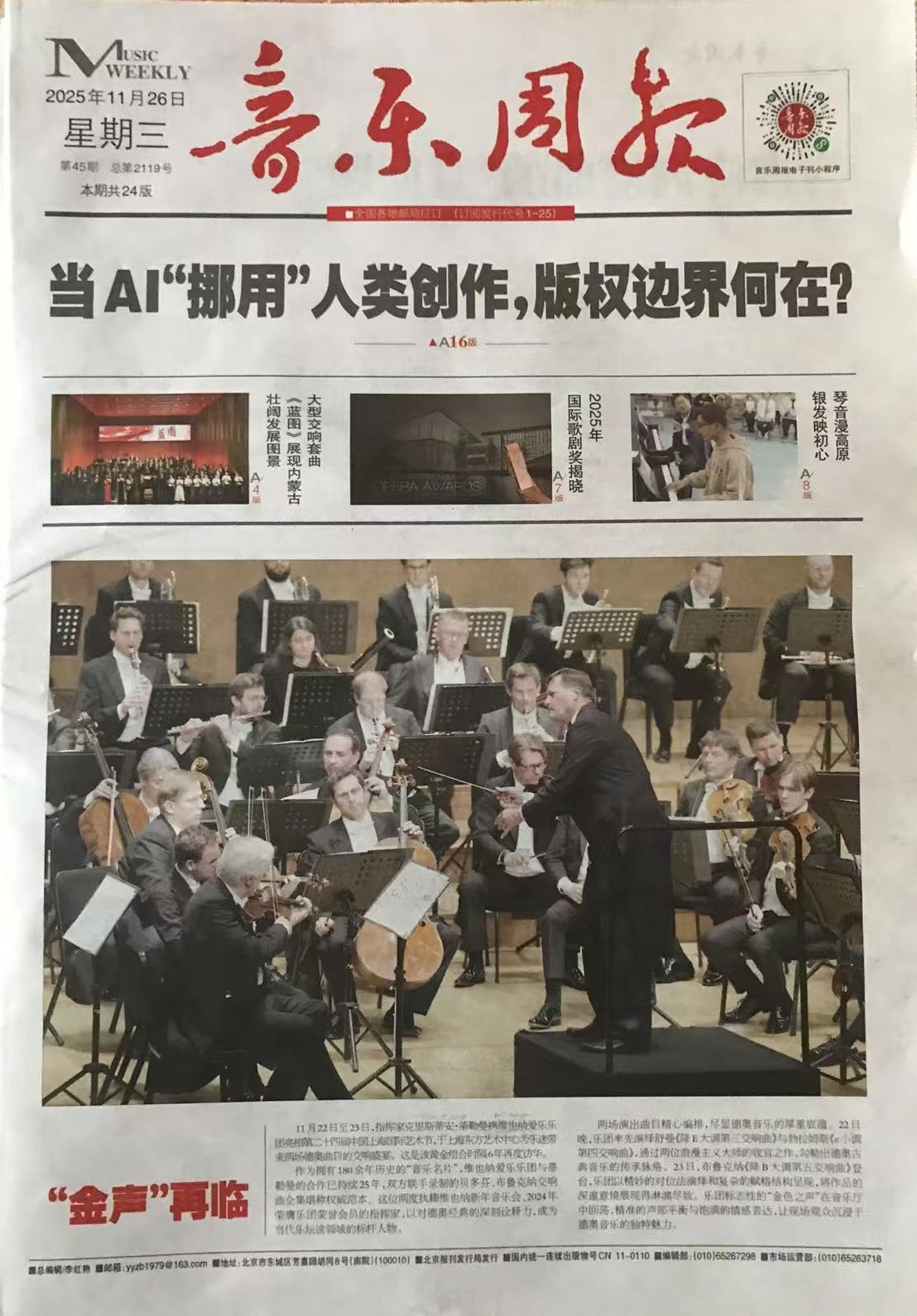





In November 2025, Carey was featured in a half-page special report in Music Weekly — China’s most authoritative professional classical-music newspaper.
The article, titled “Carey Tan: A 12-Year-Old Who Writes Symphonies,” introduced him to millions of classical-music readers across China as:
“A young composer whose imagination and depth far exceed his age.”
Carey Tan: A 12-Year-Old Who Writes Symphonies
People often talk about “genius,” yet few have truly seen what it looks like.
Twelve-year-old Carey Tan gives this abstract word a vivid, concrete form.
He masters five instruments, and his symphonic compositions have been performed by multiple European orchestras. With a depth of thought and creativity far beyond his age, he is writing his own musical legend.
In August this year, Carey premiered his second symphony The Explorer with the Arad Philharmonic Orchestra at Vienna’s Musikverein Golden Hall, attracting international media attention.
In November, he performed the same work with the Berlin Symphony Orchestra at the Berlin Philharmonie, where more than 2,000 ticketed audience members applauded long enough to bring him back on stage three times.
In October, The Explorer earned him the “Promising Young Talent” at the Vienna International Classical Music Composition Competition—he became the youngest winner in the award’s history, and the first under 20.
Viennese critics praised the work as “not merely technique, but a reflection of life itself.” Who is this extraordinary young composer?
A natural affinity for music
At five and a half, when piano and drum teachers came to tutor his nine-year-old brother, Carey would fall instantly silent, fully absorbed in the world of sound. This instinctive connection to music led him to begin his own piano and drum lessons.
From the first moment he touched an instrument, his remarkable talent was unmistakable. His sight-reading ability was especially striking—he could play a new score fluently at first glance and memorize it completely after just three or four runs.
His record-breaking milestones soon followed:
- At age 8: earned the ABRSM ARSM Piano Performance Diploma, becoming one of the youngest ever
- At age 9: passed Trinity College London Drum Kit Grade 8—youngest in UK history
- At age 11: achieved ABRSM Percussion Grade 8 (marimba, timpani, etc.), again the youngest ever
All of these records still stand today.
Meanwhile, he studied woodwinds, brass, and strings to understand their colours and expressive capabilities.
As he said, “I might not play every instrument beautifully, but as long as I grasp the essentials, it helps my symphonic writing enormously.”
Early works and rapid artistic growth
At age six, without guidance, he composed his first piano solo Canatio Waltz purely by intuition and instinct.
When he entered a boarding school in Oxford at age eight, he joined three music groups:
playing piano in the orchestra, percussion in the wind band, and singing in the choir.
He also founded a pop band in which, unlike others who covered existing hits, every performance featured his own original songs.
His composing talent soon caught the attention of his teachers. They encouraged him to challenge orchestral writing and taught him composition software. Determined to understand every instrumental voice, he learned them one by one.
At nine, he finished his first symphony The Four Seasons of Summer fields, inspired by the campus life at his boarding school. This piece won him the Silver Award at the World Classical Music Awards—he was the only child in the competition’s history to ever win. In 2024, the work was performed publicly in Shenzhen, where he played the marimba on stage.
To objectively assess his composition ability, his mother enrolled him in the University of West London’s composition diploma exam (ALCM)—whose minimum age requirement is 16 and whose candidates are usually undergraduate composition majors. After reviewing his portfolio, the exam board granted him special approval.
He completed a 30-minute submission including solo, chamber, and orchestral works, and passed with excellent results, becoming the youngest person in UK history to do so.
The news spread in British music-education circles, and the Oxford Mail featured him under the headline:
“Oxford Boy, 11, Passes University-Level Composition Exam.”
To dispel doubts about authorship or AI assistance, he posted a video showing himself composing multiple orchestral parts simultaneously in real time—clear, fluent, and unequivocally his own.
“My mind shows me movie-like scenes,” he said. “I just write the music that fits them.”
To date, he has composed over 30 classical works.
Recognition on the international stage
As European critics and media reported on him, his name began circulating in the classical world. Several agencies attempted to sign up the “musical prodigy,” but his parents declined. Instead, many music institutions offered venues and orchestra resources, enabling his collaborations with the Arad Philharmonic and Berlin Symphony at world-class concert halls.
His third symphony, The Cry of War, has been selected as the theme piece for next year’s Vienna International Youth Arts Foundation charity gala. It will return to the Golden Hall on August 6 to raise funds for children in war zones. Several major orchestras are in talks to include his works in their 2026–2027 seasons.
He is now composing his fourth symphony, Human Civilization: A Chronicle of Rise and Fall, exploring technology, society, and human nature through a sci-fi lens. Industry insiders are astonished that every new work shows clear, rapid progress. An Austrian critic described him as:
“A musical dark horse galloping through multi-dimensional time—an ancient, profound soul housed within a 12-year-old body.”
A well-rounded mind: more than a prodigy
Carey does not come from a musical family—both parents are PhDs in science and engineering. They respect his interests and provide space for free growth.
Beyond music, his abilities are equally impressive:
- Academics: self-studied high-school mathematics and physics; multiple UK Math Olympiad gold medals
- Languages: fluent in Chinese, English, French, and German; passionate about Latin and Ancient Greek, able to read classical texts
- Sports: golf, tennis, kayaking
- Personality: focused, humble, balanced
When asked about the future, he answers plainly:
“I want to study theoretical or quantum physics, but I’ll never stop making music.
I’ll always compose, always perform.”
For him, music is both a form of self-expression and a bridge to communicate with the world.